.jpg)
.jpg)
.jpg)
.jpg)

News


Grief Recovery Begins January 5
December 31, 2025
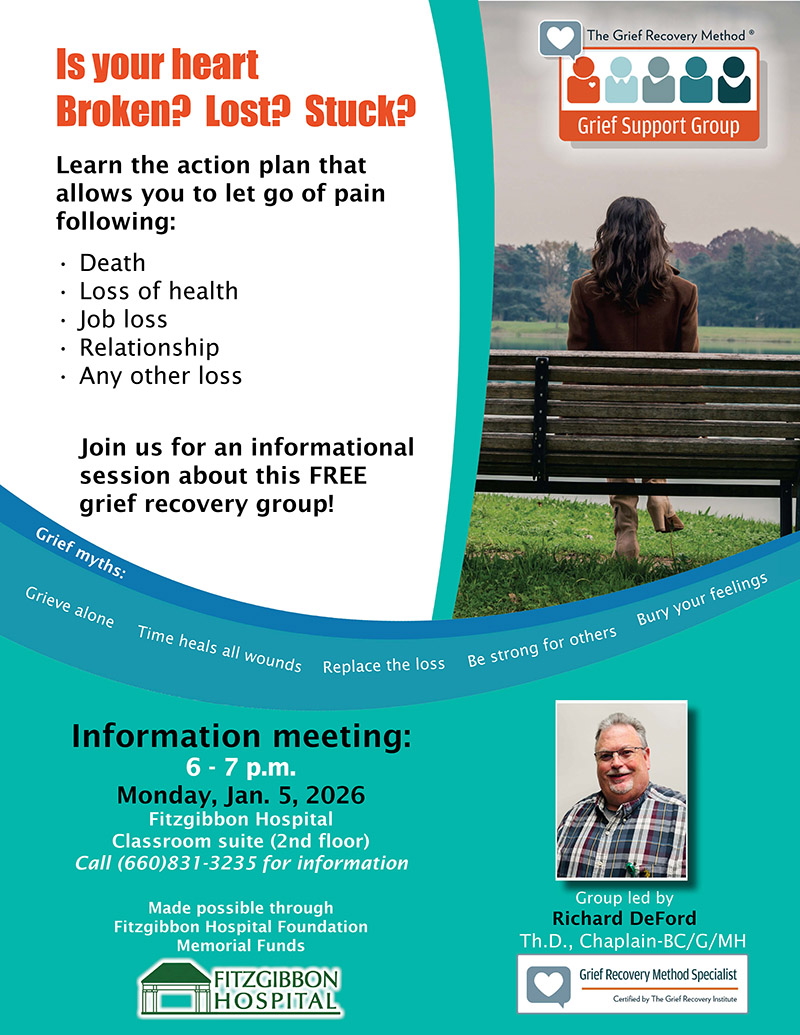
People who are grieving the loss of a loved one, a marriage or one of more than 40 other losses have a program to help them move to a better place in their grief, thanks to the Grief Recovery Program made possible by the Fitzgibbon Foundation in conjunction with the Fitzgibbon Mary Montgomery Hospice Memorial Fund. The eight-week program begins with a community meeting for anyone who wants to find out more about grief and what the program entails. That meeting will be from 6 to 7 p.m., on Monday, Jan. 5, in the classroom suite at Fitzgibbon Hospital. The program is completely free, including the book that is provided.
Attendees who have experienced every type of grief will learn the tools needed to help heal their broken hearts. In addition, via these tools, they will be able to apply them to any type of grief they have had or will experience. The group is guided with a specific curriculum. Individuals split into small groups during each session prior to discussion. They are instructed to leave all judgements, analyses or comparisons out of the small group sessions so a safe environment is created for all, regardless of the source of their grief.
“Since grief is a matter of the heart, not the mind, we have to move beyond simple knowledge and get to a place where we see how our experiences in the past and the present affect our grief,” said Board-Certified Chaplain Richard DeFord. “Often, as we work through these very powerful, very simple tools, we begin to see patterns in our lives that have deepened our grief. Many tend to focus and heal from one instance of grief. But they quickly come to realize that the pain they are experiencing is deepened because of previous instances that have not been properly dealt with.”
When someone has experienced the loss of a loved one, it can truly be hard to know
what to say. The natural response to something that seems broken, like the heart of another person, is a desire to “fix” it. However, understanding that we do not have the ability to “fix” the hurt someone is feeling is the first step to helping heal them. Offering your presence and your assurance that you are there for them as long as they need, without any judgement, can speak volumes more than any of the well-meaning comments listed above.
“There are many things we say because we want to be supportive, but ultimately our words can wound rather than heal,” said DeFord. “One of those myths is that ‘time heals all wounds.’ The fact is, time does not heal all wounds. Over time, we may learn to adapt to a new normal. We may learn to think or respond differently. We may even learn to ‘get by.’ But when you lose someone that was such a big part of your life, it is like losing a part of you. That doesn’t just heal.”
Another challenging phrase to deal with that well-meaning people will often say is that your loved one “is in a better place.” While that may be true, it is of little consolation when the person grieving really believes that the best place for their loved one is by their side. Such statements can, at times, result in anger directed at God or other individuals who may not have had anything to do with the loss. It may also be seen as dismissive of the pain someone is feeling, as if being told, “You shouldn’t mourn, it is selfish. Your loved one is in a better place.”
“I truly believe that most people really want to offer consoling words because they feel helpless to make things better. But the problem is, when you are in the midst of grief, those words can feel very empty,” said DeFord.
If you are in the midst of grief and would like to learn tools to help you move to a better place in handling it, Fitzgibbon Hospital’s free Grief Recovery Program runs for eight sessions beginning Jan. 5. To learn more, contact Richard DeFord at (660) 831-3235 or visit www.fitzgibbon.org/grief.